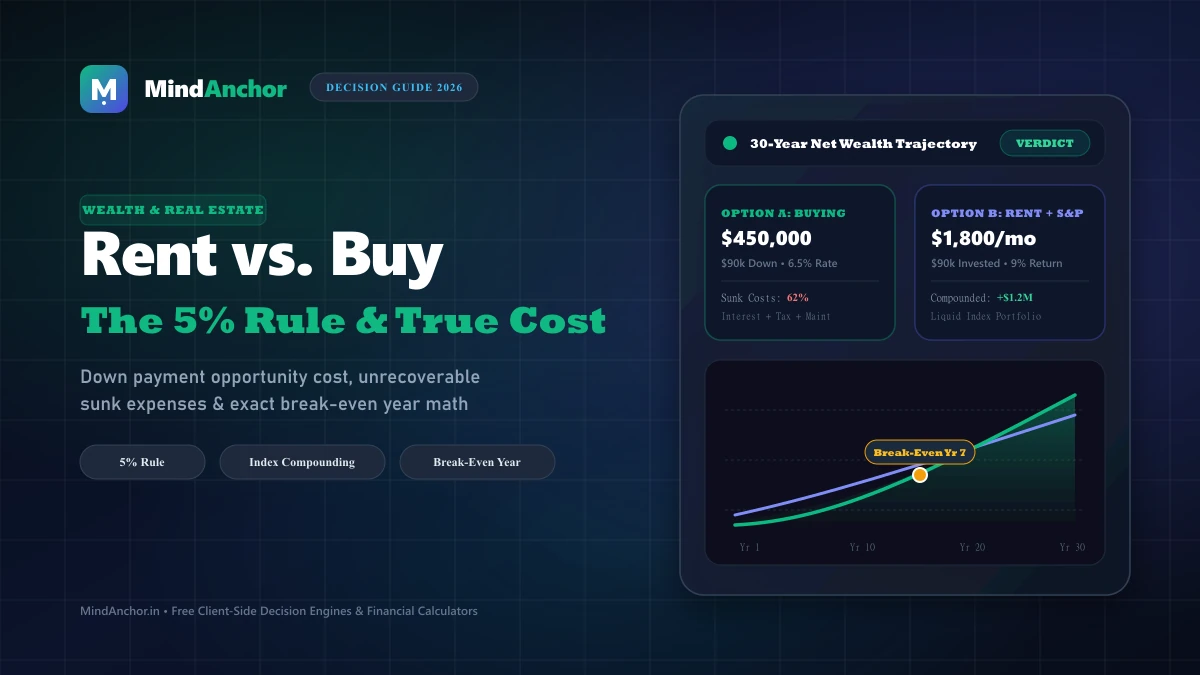
The Emotional Trap of "Rent Is Throwing Money Away"
Few financial beliefs in modern society are as deeply ingrained—and mathematically flawed—as the idea that "renting is throwing your hard-earned money away, while buying is always an investment."
From parents to real estate agents, the conventional wisdom insists that a rent check is 100% wasted money, whereas every mortgage payment builds permanent wealth.
In 2026, with mortgage interest rates hovering between 6% and 7% and home price-to-rent ratios at multi-decade highs, this myth is causing millions of aspiring homebuyers to make the most expensive mistake of their lives.
The reality is that both renting and buying have unrecoverable sunk costs. The only rational way to make this life-altering choice is to strip away the emotion, understand the cold math, and calculate your exact personal break-even horizon.
The 3 Invisible Sunk Costs of Homeownership
When you rent an apartment for $2,000 a month, your maximum financial liability is exactly $2,000. If the boiler explodes, the roof leaks, or property taxes double, your landlord pays for it. Rent is the maximum you will pay for housing.
When you pay a $2,800 monthly mortgage, that is only the minimum you will pay. Homeownership carries three massive unrecoverable "sunk costs" that build zero equity:
1. Front-Loaded Mortgage Interest
On a $360,000 30-year mortgage at 6.5%, your monthly Principal & Interest (P&I) payment is roughly $2,275.
2. Property Taxes & Insurance
Property taxes in the US average 1.1% to 2.4% of your home's assessed value annually, while insurance runs $1,200 to $2,500+ per year. On a $450,000 home, that is $500 to $800 every month paid to local governments and insurance companies that builds zero net worth.
3. Maintenance, Repairs & Depreciation (The 1% Rule)
Houses are depreciating physical assets sitting on appreciating land. Roofs decay, HVAC units fail, water heaters burst, and siding deteriorates. Economists estimate annual maintenance costs at 1% of the property value per year ($4,500/year or $375/month on a $450,000 home).
Key Rule: When you add mortgage interest + property taxes + home insurance + maintenance + HOA fees, over 60% to 70% of a homeowner's monthly outflow in the first 7 years is completely unrecoverable sunk cost.
The 5% Rule of Thumb (The Ben Felix Model)
To quickly compare renting vs. buying without opening a spreadsheet, portfolio manager Ben Felix developed the 5% Rule.
The 5% Rule calculates the total annual unrecoverable cost of owning a home as approximately 5% of the property's purchase price:
$$\text{Annual Sunk Cost} = \text{Property Value} \times 5\%$$
Where does the 5% come from?
1. 1% Property Taxes: Average annual municipal tax assessment.
2. 1% Maintenance & Capital Repairs: Cost of maintaining the physical structure.
3. 3% Cost of Capital: The gap between mortgage debt / equity opportunity cost and real property appreciation.
How to Use the 5% Rule:
Multiply the price of the home you want to buy by 5%, then divide by 12 months:
$$\frac{\$450,000 \times 0.05}{12} = \$1,875 / \text{month}$$
If a comparable 3-bedroom house rents for $1,600/month, you are throwing away less money renting than you would in unrecoverable homeowner expenses!
The Hidden Power: Opportunity Cost of the Down Payment
When you purchase a $450,000 home with a 20% down payment, you hand over $90,000 in liquid cash. That money is now locked inside walls and shingles.
Real estate historically appreciates at roughly 3.5% to 4.5% annually over long horizons (just beating inflation).
Meanwhile, a broad low-cost index fund (such as the S&P 500 or Total Stock Market Index) has historically compounded at roughly 9% to 10% annualized over multi-decade periods with dividends reinvested.
The 30-Year Compounding Comparison:
What happens if that $90,000 down payment is invested in an index fund on Day 1 instead of a mortgage down payment?
| Horizon | Home Equity Growth (at 3.8% Apprec.) | S&P 500 Index Compounding (at 9% CAGR) | The Opportunity Cost Gap |
|---|---|---|---|
| Year 5 | $108,440 | $138,476 | +$30,036 in Stocks |
| Year 10 | $130,660 | $213,062 | +$82,402 in Stocks |
| Year 20 | $189,720 | $504,397 | +$314,677 in Stocks |
| Year 30 | $275,480 | $1,194,095 | +$918,615 in Stocks |
A disciplined renter who invests their down payment in index funds accumulates over $1.19 Million in liquid portfolio wealth from that initial capital alone—without paying a single plumber, replacing a roof, or paying property tax bills.
Side-by-Side Financial Comparison: Year 1 Sunk Costs
Let's look at the actual cash flows of two individuals living in the same neighborhood:
| Expense Category | Alex (Homeowner) | Jordan (Renter & Investor) |
|---|---|---|
| Initial Capital Required | $90,000 down + $9,000 closing costs | $1,800 security deposit |
| Total Monthly Outflow | $2,950/mo (P&I + Tax + Ins + Maint) | $1,800/mo (Rent + Insurance) |
| Unrecoverable Sunk Cost (Year 1) | $27,150 / year (Interest + Tax + Maint) | $21,600 / year (100% of Rent) |
| Monthly Cash Savings | $0 | +$1,150 / month (Invested in Stocks) |
| Liquidity & Mobility | Low (Tied to property; 6% sales fee) | 100% Liquid (Can move anytime) |
In Year 1, the homeowner actually throws away $5,550 MORE in sunk unrecoverable costs than the renter does!
Why You Almost Always Lose Money Selling in Under 5 Years
When you sell a home, you encounter the friction costs of real estate transactions:
On a $500,000 home, selling costs wipe out roughly $35,000 to $40,000 right off the top.
Because mortgage amortization is so heavily front-loaded with interest, you build very little principal in the first 36 months. Unless you experience an anomalous housing bubble, anyone who buys a home and sells within 3 to 5 years almost always loses money compared to renting.
Test Your Exact Numbers: The Free Decision Engine
General rules of thumb are helpful, but your decision depends entirely on your local market, property tax rates, rent prices, and personal investment horizon.
We built the [MindAnchor Universal Rent vs. Buy Decision Engine](/rent-vs-buy-calculator) to help you simulate this decision month-by-month over 30 years:
👉 [Launch the Rent vs. Buy Decision Engine Now](/rent-vs-buy-calculator)
The 5 Golden Rules Before You Sign a Mortgage
Before taking on a 30-year mortgage, make sure you can check all five boxes:
1. You Plan to Stay for at Least 7 Years: Give your property sufficient time to overcome front-loaded interest and 6% broker sales fees.
2. Your Total Housing Cost Is Under 28% of Gross Income: Include principal, interest, property taxes, home insurance, and maintenance.
3. You Have a Separate 6-Month Emergency Fund: Never deplete your emergency savings to fund a down payment.
4. You Are Buying for Lifestyle, Not Just Speculation: Buy because you want roots, autonomy, and stability—not because you expect the house to beat the stock market.
5. If You Rent, You Actually Invest the Difference: Renting only beats buying if you are disciplined enough to automatically invest the down payment and monthly savings in low-cost index funds.